J.J. & A.W. Skeet
Surfacing and groundworks across Ryedale, York and Scarborough. Built to prove a family firm is exactly that.
Web design for builders
An extension is the biggest cheque most people will write outside of the house itself, and it comes with six months of somebody living in their garden. The website has to answer that anxiety, not just list what you do.
The problem
Building work has the longest, most anxious buying process of any trade. Months, not minutes.
Everyone knows somebody whose builder took the deposit, started, and drifted away to a bigger job. That is the fear your website has to settle, and it is settled with finished projects, a clear process, and evidence you have done this before and turned up at the end.
By the time you get an enquiry they have looked at four or five builders and ruled out three. That happened on the website, without you, and it happened on things like whether the photographs looked like the job they want doing.
Extensions get decided by couples, and they are looking for different things. One wants to know it will be finished properly and on budget; the other wants to see something that looks like the room they are imagining. The site needs to do both.
A builder who does barn conversions and a builder who does kitchen extensions are not interchangeable, and a customer with a listed cottage needs to know within seconds whether you are the right firm.
What it needs
Evidence, process, and specificity.
A grid of thumbnails is decoration. A page per project: what the customer wanted, what was involved, what it looks like now, with before shots if you have them, is the single most persuasive thing you can publish. Two or three done properly beats thirty photographs.
Survey, drawings, planning or permitted development, quote, start date, stages, payments, sign-off. Setting out the process calms the exact fear that stops people committing, and almost no builder bothers.
Saying "we do extensions, renovations and barn conversions, we do not do new-build estates" makes you the obvious choice for the right customer and saves you quoting for the wrong ones.
Structure
Builders usually want the ten-page package, because the project pages are the site.
Your best finished project, what you do, where you work, and how to start a conversation.
Extensions, renovations, conversions, new builds, groundworks. One page each where you genuinely do them and want more of them.
The index, then a page per project. This is where the work is won.
The stages from first call to handover, including how payments are staged. Directly addresses the fear.
Who you are, how long you have been building, who is on the team. Faces help enormously here. This is a trade where people are letting you into their home.
Where you work and roughly how far you travel.
Phone, form, and what happens after they send it.
Mistakes
Skips, scaffolding, mud, a half-rendered wall. Understandable, and the wrong thing to lead with. Go back and photograph two finished jobs in decent light. It is worth a Saturday morning.
A homeowner with a £40,000 extension budget cannot tell whether you are interested. A line about the typical size of job you take on saves both of you a wasted quote.
Planning permission is the thing customers understand least and worry about most. A builder who explains it plainly looks more competent than one who does not mention it.
Work
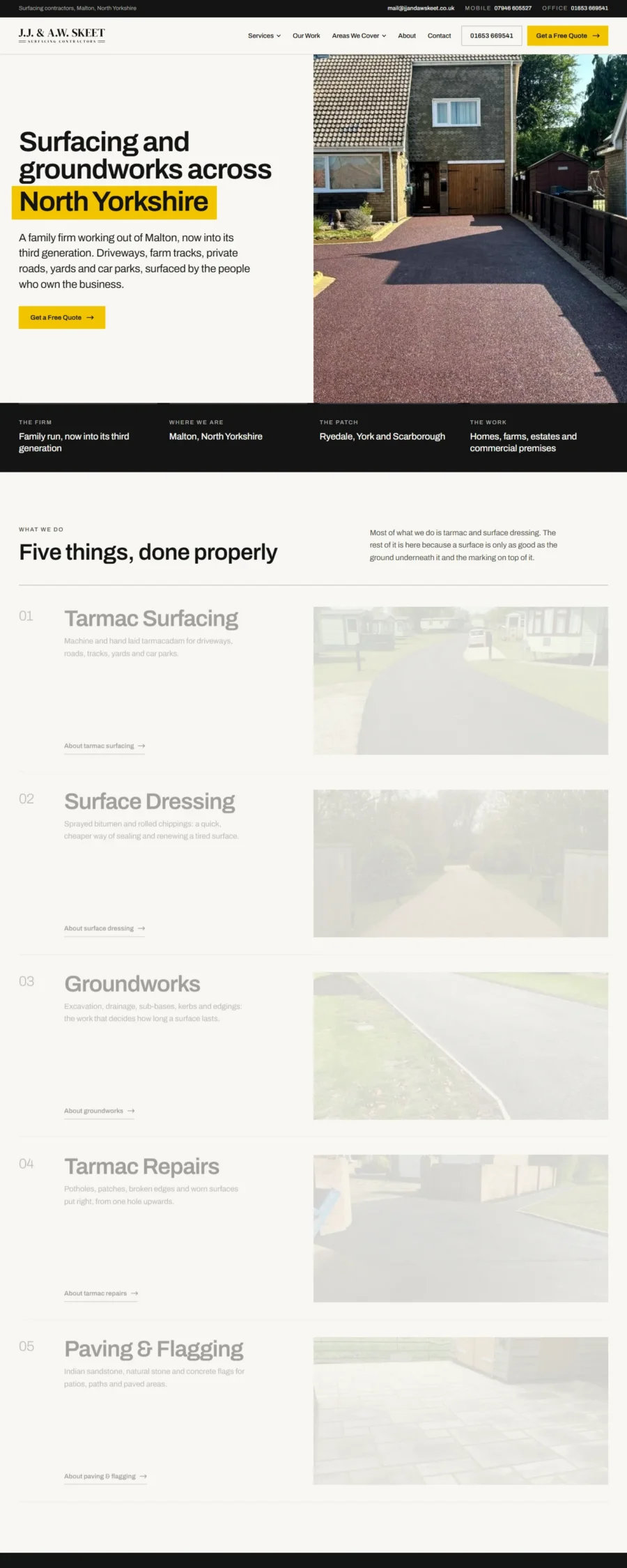
Surfacing and groundworks across Ryedale, York and Scarborough. Built to prove a family firm is exactly that.
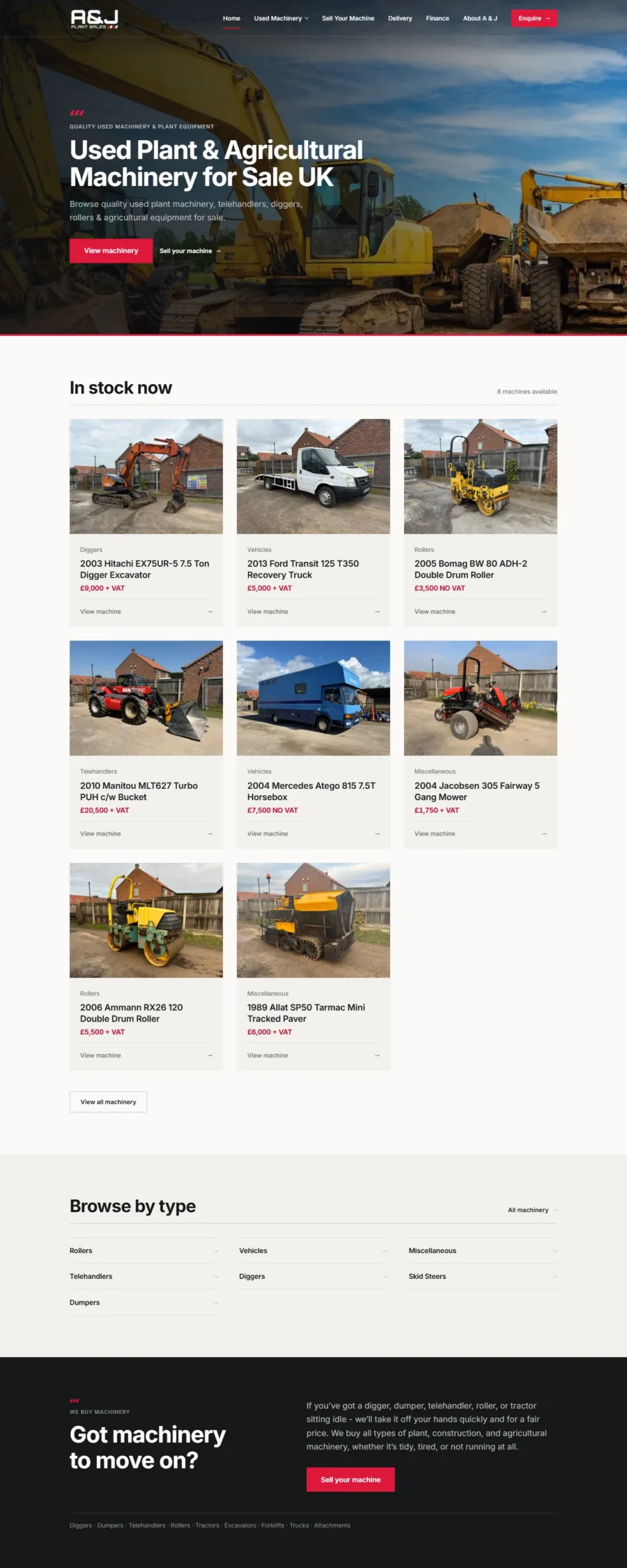
A filterable machinery listing with a page per machine and a sold archive, run entirely by the dealer.
Pricing
The same published prices as everyone else pays. No sector premium.
Up to 5 pages
£400
Recommended
Up to 10 pages
£800
Bespoke build
£1,200+
Need a page or two more than the package allows? We will quote for the extra pages before you commit to anything, so you know the full cost up front. See the full comparison.
FAQs
To choose better work. A full order book is exactly when a website earns its keep, because it lets you attract the jobs you actually want rather than taking whatever comes. A site full of high-end renovations attracts high-end renovations.
Not at all. Phone photographs of finished work are fine and often better than staged ones. Send us the lot and we will pick and crop. What does not work is only having pictures from halfway through the job.
You would not publish a fixed price for an extension and nobody expects it. What helps is honesty about the range you work in, so the enquiries you get are from people whose budget is real.
Then the site should say so. A page aimed squarely at architects, developers or commercial clients will bring in different enquiries from one aimed at homeowners. Being specific is how you filter.
Advice
A builder platform is sometimes the right answer and we will say so. But the subscription is not the real price, and there is one clause worth…
Quotes for the same website vary enormously. Here is what actually drives the price, and the four questions that tell you whether one is fair.
Most small business sites have too many pages saying too little. Here is the site most local businesses should have, page by page, and the five…
Tell us what the business does and what you need the site to do. You will get a straight answer on what it costs and how long it takes, not a discovery call.
or email hello@malnor.co.uk